Winter Olympic Games 2026
Milan – Cortina
In just 10 days, the XXV Winter Olympic Games will begin in Milan and Cortina. I’ve had the pleasure of visiting Milano—the world’s fashion capital—and skiing down the slopes of Cortina d’Ampezzo. The images of these beautiful places stay vividly in my mind, and I await with immense anticipation the spectacle and the emotional whirlwind this time will bring.
For millions of people around the globe, this event is far more than a few weeks of snowy competition. It is an era of dreams, hope, and the very essence of the answer to the question: why do we actually practice sport?
Games vs. Olympiad
Let’s start with what the Games are and what an Olympiad is. For many, these terms are used interchangeably, but in precise definition:
- The Games are the grand sports festival itself—the name of the event.
- The Olympiad is the four-year cycle between editions of this spectacle of determination and fulfilled dreams. It defines the time, rhythm of preparation, qualifications, triumphs, and failures.
Four Years of Preparation…
This rhythm, this measure of time, shows how demanding those four years are—and that often even four years are not enough. In many cases, athletes and their teams prepare not for one Games, but through several Olympic cycles before their experience matures to the point where the world can notice and reward them.
The Road to the Games
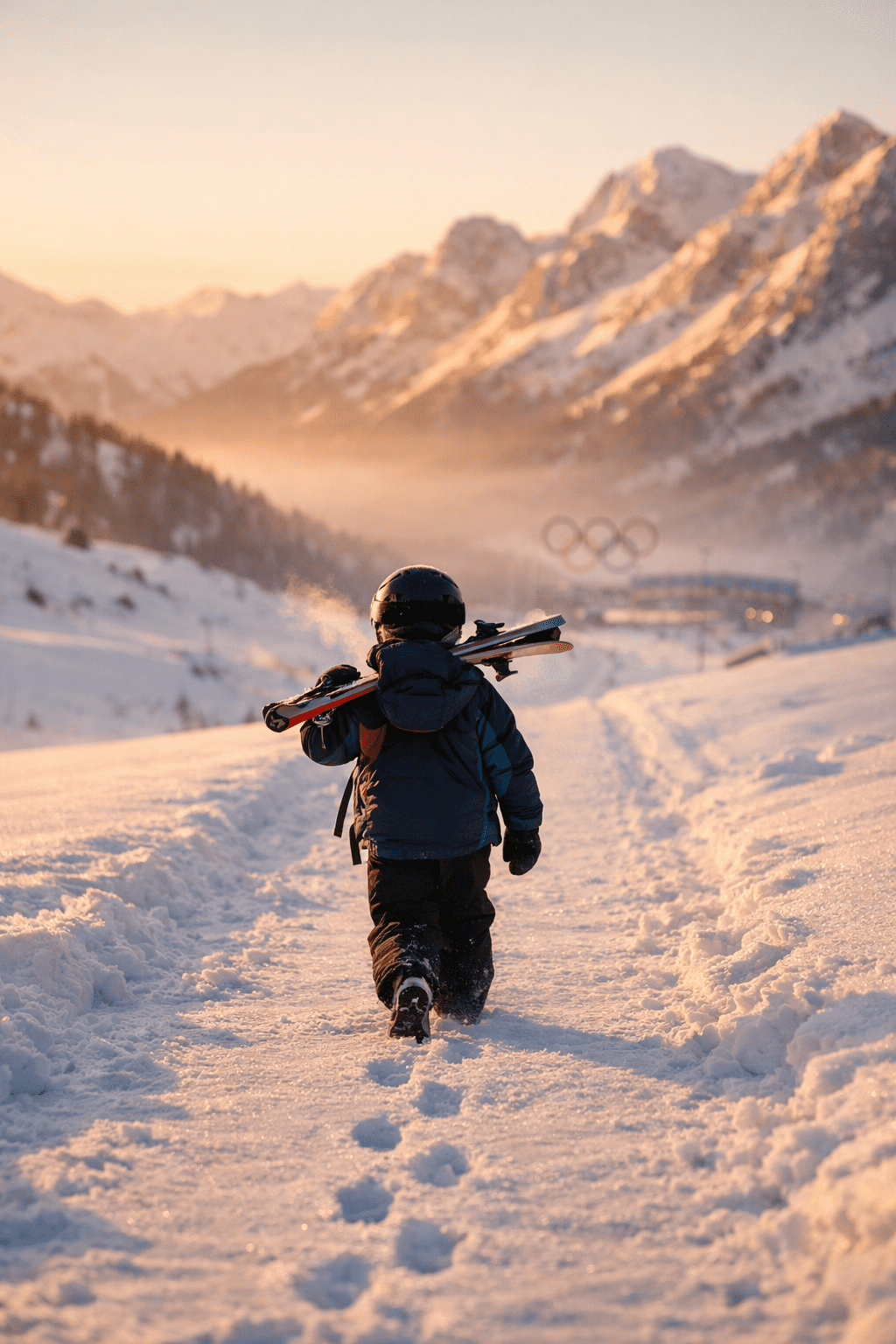
For many athletes, the road to the Olympics is the road of a lifetime, much like the photo accompanying this article. A young athlete dreams from the very beginning of their career of competing at this most important event.
This road is full of bumps, stumbles, small successes, and many failures. It is years of waking before dawn, hundreds of training hours, teams of coaches, physiotherapists, psychologists, family support, and sacrifices that cost more than money—they cost an entire life shaped around the rhythm of sport. This is not the success of one person. It is the success of a group of people who invest years of energy and time in a single goal.
And sometimes there is no team, no support. Sometimes sheer determination and willpower carry that little athlete, now in the body of a mature competitor, to the realization of their dream.
Pierre de Coubertin
Here we must recall the words of Baron Pierre de Coubertin, the most recognizable thought of the modern Olympic Games and the essence of his philosophy:
“The most important thing is not to win, but to take part.”
This is the core of Olympism: effort, struggle, and striving against one’s own limits are more important than the result on the scoreboard.
Stories That Reveal the Olympic Spirit
The Jamaican Bobsleigh Team – Calgary 1988
Their story is a symbol of courage and perseverance. A country without winter, without ice, without a winter sports tradition, fielding a team in one of the iciest disciplines imaginable. For those less familiar, bobsleigh is a high-speed descent on a specially designed sled along an icy track.
They did not finish the four-man competition, but they participated and represented their country.
Their story later became the inspiration for the film Cool Runnings.
To be precise, 1988 was their debut both as a team and as a nation in this discipline. Their best result came at the Lillehammer Games in 1994, where they finished 14th, ahead of the USA, Russia, and France.
Eddie “The Eagle” Edwards – UK – Calgary 1988
Michael Edwards – a Brit by nationality, a plasterer by trade, and his education… largely irrelevant. He had a dream: to compete in the Olympic Games. And he made it happen. With no sporting background, no real chances, and no natural predisposition.
The main obstacles (because these were not “problems,” after all) were that:
- Great Britain had no tradition of ski jumping (the last British ski jumpers had competed in the Olympics in 1928!),
- Edwards had NOTHING—no money, no facilities, no coach,
- he began training very late by the standards of this discipline, already past the age of 20,
- he had a serious visual impairment (wearing thick glasses under his goggles),
- he was physically completely unsuited for the event (too heavy for a ski jumper).
And yet—what could stop him? He wanted it, he worked, he trained, he had dreams and passion, and in 1988 he went to the Winter Olympic Games in Calgary as the first ski jumper in the history of Great Britain.
He finished last on both the normal and large hills. It did not matter. In the media, he became one of the heroes of the Games and a living embodiment of the Baron’s philosophy in its purest form.
He was not a “product of a training system,” not a favorite, not even considered “ski-jumper material.” He was a man determined to fulfill his Olympic dream, paying for training through manual labor, sleeping in cheap hotels, borrowing equipment, and learning through trial and error.
When he jumped, the entire stadium stood up. Not because he could win.
But because he had the courage to try.
His story was so symbolic that after the Games, qualification rules were changed to prevent similar cases, where someone finishing last could become a bigger star than the medalists. Stricter performance standards were introduced.
In 2016, the film Eddie the Eagle was released, capturing the spirit of this remarkable story.
Elizabeth Swaney – USA/Hungary – PyeongChang 2018
The lowest-ranked freestyle halfpipe skier at the 2018 Winter Olympics in South Korea. Elizabeth Swaney learned to ski at the age of 25 and set herself the goal of competing in the Games. Once again, determination—and a clever way of navigating the qualification system—helped her make that dream a reality.
American by birth, she represented Hungary at the Olympics, the country of her grandparents’ origin. To enter the team and secure qualification, she “collected” points by competing in as many events as possible where fewer than 30 athletes took part. She even launched a public fundraiser to finance her journey—and succeeded. She competed at the age of 33.
Of course, there were critics who described her as someone who had “gamed the system.” However, many athletes defended her right to compete, emphasizing that the effort required to meet the minimum qualification standards also deserves respect.
Isaac Menyoli – Cameroon – Salt Lake City 2002
Architect Isaac Menyoli was the first and only athlete from Cameroon in the history of the Winter Olympic Games (Salt Lake City 2002) to compete in cross-country skiing. He participated in events where his chances were minimal, but his goal was not the podium. He used his Olympic participation to draw attention to the problem of AIDS in his country and to promote public health more broadly.
Ester Ledecká – Czech Republic – PyeongChang 2018
This is not an example of a lack of skill—Ester Ledecká from the Czech Republic achieved something previously thought impossible: she won in two entirely different events at a single Olympics. She became the first person in the world to win two gold medals in completely different winter sports disciplines—snowboarding and alpine skiing.
Her story is an example of extreme versatility and courage, going beyond the traditional boundaries of a single specialization. Hard work enables an athlete to achieve what others consider impossible. This is an obvious truth, one that every athlete who has spent even a little time in any discipline understands.
Deanna Stellato-Dudek — Triumph Over Time and Limitations Milan–Cortina 2026
Since figure skating is my primary, core, and closest-to-the-body sporting language, Deanna Stellato-Dudek’s story is especially close to my heart.
In the world of figure skating, she has not only broken age-related stereotypes but practically redefined them on her own terms. At the age of 42, she is now preparing for her Olympic debut. Her journey to this point reads like the script of a sports movie, full of highs, lows, and unyielding self-belief. Perhaps someone should make that film.
As I mentioned at the beginning, she has gone through more Olympic cycles than one can count—intermittently, yes—but she also achieved her goal—full respect. Forty-two years old, training, competitions, stress. Some people at that age are wrecks, barely getting out of bed in the morning. Yet she steps onto the ice to compete with teenagers. WOW!
Her story began as a decorated junior representing the United States. She won a silver medal at the World Junior Championships, a beautiful introduction to further success. Unfortunately, at the age of 17, a serious hip injury brutally interrupted her athletic development and temporarily ended her sporting career. Thankfully, only temporarily.
Switching Disciplines
Her health did not allow the teenage athlete to continue her sport, but life went on. Work, home, daily routine—but her dreams were not put on a shelf. The turning point came in 2016, when Deanna made the DECISION to return! She changed disciplines from singles to pairs (hmmm!) with Maxime Deschamps.
Together, the pair won Grand Prix medals. In 2024, Deanna became the oldest female World Champion in figure skating—a historic achievement in its own right.
Her decision to change national representation and become a Canadian citizen allowed her to compete in the Olympics under a new flag. So, in Milan, in just a few days, we will see whether the dreams of this “figure skating retiree” come true. I am keeping my fingers crossed tightly. She is only slightly younger than me, which really makes me think.
Age is not a limitation. The only limits we have are those in our minds. It is there that we build walls impossible to climb.
Deanna is a symbol of the lifelong road to the Olympics, of perseverance, and of love for sport. Her story reminds us that dreams have no expiration date. Returning to a discipline can be essays on courage and faith in the meaning of one’s journey—even if it takes years.
The Opening Ceremony — A Spectacle of Art and Spirit
I also cannot fail to mention the Olympic opening ceremonies. Since childhood, I have held my breath watching these spectacular performances, where the world becomes one and art blends seamlessly with sport. Every parade of nations, every dance, every light and piece of music creates a small-scale global spectacle. They build an atmosphere of unity, joy, and a celebration of human effort. The creativity and surprises of these shows can hold my attention for hours—because they are long. And the very moment the Olympic flame is lit always brings a tear to my eye. It is a magical experience for every athlete.
A Bit of History
In their original historical context, the Games were a religious and cultural festival. In ancient Greece, they were held in honor of the gods, especially Zeus, at Olympia.
They combined athletic competition, art, prayer, and the community of city-states. Athletes competed to demonstrate virtue, courage, and the perfection of body and spirit.
This tradition has survived in the modern Olympics: today we have medals and worldwide broadcasts, but the essence remains—participation, effort, and the shared celebration of human potential. At least, that is what I hope.
The Celebration of Sport Is Almost Here
I am eagerly awaiting the 2026 Winter Olympic Games. Italy—a country of fashion, passion, talent, art, and ancient culture—will host such a beautiful event. I look forward to the opening ceremony and the competitions, remembering the Baron’s philosophy: participation itself is a success, while victory is an additional reward (yes, I know, athletes compete to win) and a culmination of years of hard work.
So, dear fan, please remember: we have no right, sitting on our couch, eating chips and sipping beer, soda, or coffee, to criticize those who dedicate years of their lives to win a medal—or simply to overcome themselves.
Every start, every training session, every drop of sweat and every tear is part of something greater. It is the journey, not just the result, that is the true success—the path of a child realized in a mature sporting body and mind.
Let us show respect to every athlete, because in a way, they perform for the audience, giving us emotions we may have experienced—or would love to experience.
Let the upcoming Games in Milan and Cortina be a reminder that the Olympic ideals of fair play, effort, and respectful competition are what make sport a universal language.
Let us cheer with full engagement, and admire the journey, not just the medal. Every Olympian, regardless of the result, has already achieved something extraordinary.
Attention! Attention!
A HA!!!!
Finally, one most important message: cheer for all athletes.
Do not call our Polish representatives “bunglers,” and do not judge from your couch what cost them years of effort, sacrifice, and dedication. Let our attention and support extend beyond our own national team (60 athletes).
Cheer sincerely and from the heart for anyone who dares to step onto the boards, ice, arenas, and slopes of this most important event for any athlete.
Every start, every jump, every race is a triumph of spirit deserving admiration. It is precisely this courage and determination that create the true beauty of the Olympic Games.
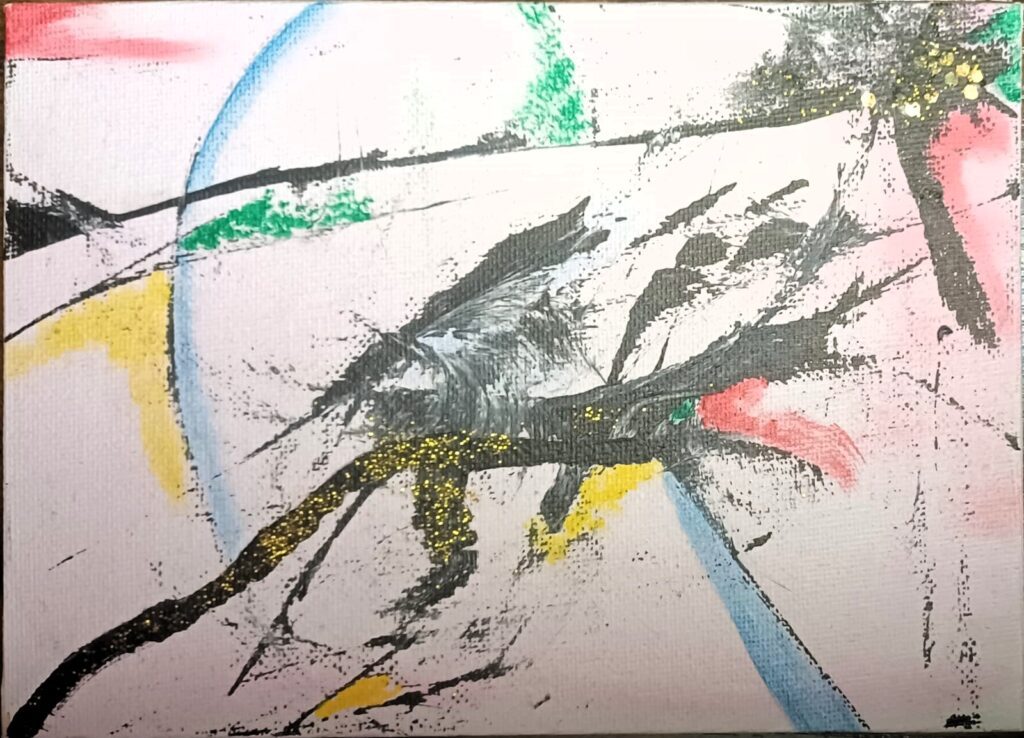
Acrylic on canvas – Olimpics
P.S.
If you are an athlete and dream of truly preparing for competition—regardless of age, skill level, or discipline—or if you are a parent or a conscious coach, and you want to support young and older talents in a thoughtful and effective way…
I am happy to share my knowledge, experience, and proven methods.
Together, we can plan a path that will turn your goals into reality — and who knows, maybe we can even achieve some real miracles!