
When the Brain Hits the Emergency Shutdown on Its Own Nuclear Power Plant
The Games and just like that, over in a flash.
The most important competitions in athletic careers have just come to an end. A beautiful opening, a stirring finale. That time of extraordinary battles on the snow-and-ice arenas of the Winter Games passed quickly.
What now? A “day” of silence, a moment to catch one’s breath. And then a new four-year Olympic cycle begins.
Today, no one is thinking about what will happen in four years. The anthems are still playing, the medals are still gleaming, athletes are returning home and meeting family, friends, and acquaintances. Some celebrate gold, while others try to piece themselves back together after what was meant to be the moment of their lives — but something misfired, and instead of returning on their shields in glory, they come back with their tails between their legs. Entirely unnecessarily, by the way. Still, failing to meet your own expectations hurts. That’s a FACT.
A Moment of Reflection
Perhaps this is exactly the right time to pause for a moment and shift perspective.
What, really, is success?
Is it only a place on the podium?
Exclusively a medal position recorded in the standings?
Or could victory also mean climbing out of a slump, rising after a mistake, overcoming yourself, fulfilling a dream, making an upward move — even if it doesn’t lead to the very highest summit?
The summit is spectacular, loud, sometimes surprising even for those who reach it.
Climbing out of an abyss is quieter. Fulfilling a dream can lift us on wings within our close circle, without fireworks. Either way, it still matters.
Figure Skating – An Enduring Passion
As you know perfectly well, dear Reader, figure skating is a discipline incredibly close to my heart — for obvious reasons. That is precisely why the men’s final became the impulse for this reflection.
The article you are reading will not be an analysis of jump technique, step sequences, music choices, or component scores. In light of what happened on Friday the 13th, 2026, this will instead be an attempt to shift the angle from which we view athletes.
I will not hide the fact that my level of astonishment carved irreversible wrinkles into my forehead, and my body felt waves of adrenaline as if I were personally experiencing a command-system failure.
How do I know what that feels like? Well, a long, long time ago, I got so fired up about a fantastic program I had prepared and wanted so badly to present it that… my memory system shut down, and I forgot what I was supposed to skate.
The experience of an eleven-year-old child competing in Warsaw is incomparable in rank to champions starting at the Olympic Games — yet on the level of emotions and competitive readiness, I believe it is comparable.
Times have changed. Our expectations of ourselves, not necessarily. Whether we are 11, 18, 21, or 50, we want to win. The problem, I believe, is the extreme pressure — the excess of expectations amplified by inflated media noise and narrative chatter, which overloads the nervous system even more intensely.
Defense System
Fundamentally, it is not the body that loses. It is the system that manages the body. The brain, like in a nuclear power plant under overload conditions, presses the emergency shutdown button. The red light cuts off power to protect the organism.
It does not matter whether the threat is real or “only” psychological. For the nervous system, pressure can be just as dangerous as a physical injury. The button is pressed — and that is the end of it.
On one side, we saw an athlete whose system “shut down” — the red button pressed against his will, and… nothing could be done. In fact, he does not even remember it.
On the other side, a female athlete who, despite a serious injury, stepped onto the ice. It ended dramatically: a painful fall, real injuries, suffering. The medal ceased to matter. Her health was wrecked along with it.
And the question arises: was it worth it?
Limits
Between psychological overload and excessive physical overreach lies a thin boundary.
In one case, the system cuts the power to save the person — neural circuits overwhelmed.
In the other, the person ignores warning signals from the body until the body itself decides, forcing a stop.
Both situations speak about the same thing: limits. And about the fact that in 21st-century sport, the battle is increasingly not only for a medal, but for maintaining balance between ambition and safety.
So — let’s begin.
Friday the 13th. For Some, Bad Luck — For Others, an Unforgettable Spectacle
Friday the 13th has been surrounded by legends for centuries. In Western culture, the number 13 is considered unlucky, and Friday — historically associated with tragic events — only reinforces that narrative.
Some shrug it off. Others subconsciously feel tension. Superstition is superstition, but a black cat crossing your path… you know what I mean. Every person has their own charms and rituals. For athletes, those are pre-performance routines. Either way, the men’s figure skating final fell unmistakably on a “cursed” date.
I encouraged friends to tune into the broadcast. It was supposed to be a top-tier spectacle. The athletic level — astronomical. The names alone guaranteed an unforgettable show. The rivalry looked magnificent on paper.
And indeed — the final was unbelievable.
And unforgettable.
Just not in the way anyone expected.
A Spectacle of Errors Instead of Perfection
Instead of flawless programs packed with the most technically demanding jumping elements, cascades of spins, and miniature dance theater, we witnessed the opposite. Falls. Stumbles. A fight to maintain control and balance.
Artistic intention was sacrificed to survival. Metaphorically — and at times almost literally.
This was not a display of dominance.
We witnessed a spectacle of survival.
These words are not meant to be malicious; they are not coming from the comfort of a couch and a bag of chips. I personally felt every mistake, every misstep. The disbelief and stress that evening — shared by nearly all competitors — transmitted through the screen. That was the kind of energy in the arena.
At moments, I had the impression that some sort of fatal force hovered above the ice. As if the pressure were larger than the arena itself. As if the athletes’ nervous systems were operating at the edge of overload, disturbed by some external interference in the energetic field. As if someone had switched on devices scrambling the signal.
And that was when a question more important than the result emerged:
What happens to a human being when, under pressure, the brain presses the red emergency button?
Exactly what happened to Ilia Malinin. He had a wide, competition-free highway — a straight stretch with no obstacles — leading directly to the gold medal. His rivals had effectively removed themselves from the approach path through their own errors. All he had to do was step in, deliver what he always delivers, and collect what seemed “destined” to be his. Nothing simpler — and yet nothing more difficult.
Failure in sport is not an accident at work. It is part of the profession. It must be processed.
Training, recovery, nutrition, technical analysis, metrics, speed, precision, ballet, running, and a hundred other components — these are obvious elements of an athlete’s work. Everyone knows they must be planned, measured, and developed. Add mental preparation, motivation, positive reinforcement.
But failure?
We still treat failure as something that “should not happen.” As a system defect. The very thought of it makes us cold; goosebumps rise across the body.
From the perspective of sports psychology, however, failure is as natural a component of a career as muscle overload after an intense training cycle. It is not an anomaly — it is an adaptive process.
It is not that losing is good.
It is that it is inevitable.
And yet no one really prepares us for it. We do not talk about the feelings — about those emotions associated with failure, that terrifying monster. We avoid the conversation, afraid of jinxing success, afraid that affirming victory might somehow be undone by acknowledging its opposite.
Why Does the Brain “Shut Down”? The Mechanism of an Overloaded Nervous System
In situations of extreme competitive pressure (and “extreme” is relative for each individual), the nervous system shifts into threat mode. Cortisol and adrenaline rise. The body prepares for fight or flight.
We are taught about the stress-performance curve — the inverted-U parabola. We try to “hit” peak form at that optimal point on the rising wave, where cortisol and adrenaline enhance performance rather than disrupt it.
Through repeated competitions, we train ourselves to regulate emotions in order to maintain consistent access to higher-order cognitive functions: concentration, motor control, sensory integration.
But when arousal exceeds the optimal threshold, under the influence of stress hormones, the organism begins to malfunction:
- attentional focus narrows,
- motor precision declines,
- automatisms cease to be automatic,
- “choking under pressure” emerges — a decision-execution paralysis.
From the outside, it looks like: “He suddenly forgot how to jump.”
In reality, an overloaded nervous system activates a protective mechanism. The brain attempts to survive excess stimulation by cutting off access to certain functions.
What Actually Happens in the Mind?
In interviews, Ilia described not knowing what was happening to him, being unable to “pull himself together,” not remembering parts of the performance — experiencing intrusive images of trauma and catastrophe. That is a classic anxiety-response pattern: panic, fear, frustration. The perspective of falling from the towering horse of expectations. Catastrophic thinking.
The higher the expectations, the greater the amplitude of the fall.
A gold-medal favorite carries:
- ranking pressure — I am the best,
- fan expectations — all the quads at the Games,
- sponsor investments,
- personal ambition — I am the god of quadruples, eyes closed, at midnight,
- the narrative — this is his moment.
When a mistake appears, it is not merely a deduction in the Grade of Execution. It becomes a fracture in athletic identity.
Millions of questions surface: What now? What does this mean?
This is the critical moment in an athlete’s development.
Not the start. Not the podium.
This fall — especially on the most important sporting stage of a lifetime.
Emotions After Defeat
The emotions immediately after the performance are one thing.
The next day — likely after a sleepless night, physically or mentally crying into the pillow — is another.
But what comes next? One must confront all the external burdens and expectations once again.
Physical fatigue blends with a mental hangover. And then begins the most difficult phase: ordinary life after defeat.
The competition ends. The internet does not. The media does not. One’s own memory — even less so.
Shame appears. Often stronger than sadness.
Shame that “I failed” — and everyone saw it.
I was the favorite.
It was supposed to be different.
Add to that fear of judgment, avoidance of eye contact, bodily tension at the mere thought of watching the replay. The mind begins replaying the errors like a looped recording — relentlessly.
What happened once starts living in the future.
Because the next Games, the next championships, the next competition will no longer be “clean.” A similar arena, similar music, a similar competitive situation — and the nervous system will remember that moment. Without fail.
The body will react faster than thought. Heart rate will accelerate. Palms will sweat. Muscles will stiffen.
This is not weakness.
This is neurobiology.
Overwriting Painful Experiences
In skydiving, when someone is forced to deploy the reserve parachute, they often return quickly for a second jump. The goal is to “overwrite” the experience while it is still fresh — before fear embeds itself in the nervous system. To do it again, safely, so the brain does not encode the situation as trauma.
But in a sport like figure skating — how do you overwrite it?
You cannot always “jump again immediately.” Top-level competitions take place every few months; the Olympic Games come once every four years. Time functions differently. That is why the process must be more deliberate and structured.
What Are the Procedures?
First, emotions must be allowed to run their course. They should not be silenced with a narrative like, “Nothing happened.”
Something did happen.
And it hurts.
Shame, anger, disappointment, a sense of injustice — these are natural physiological responses to the loss of something that was a real, invested goal.
Then comes the stage of meaning reconstruction. Separating fact from interpretation.
Fact: I made mistakes.
Interpretation: I am hopeless.
The first can be processed.
The second will destroy us.
Fear of the next competition does not disappear on its own. It requires new embodied experiences. Smaller events. Controlled environments. Gradual exposure to the stimulus that previously triggered overload.
The nervous system must relearn that the arena is not a life-threatening environment.
If this process is absent, the brain may press the red button again — for safety. Even if the “threat” is merely evaluation or expectation.
The truth is also this: once the system has overheated, we already know — through experience — what triggers it. That extreme episode gives us data. We become capable of recognizing the pre-failure state.
So the key question is not: how do we forget?
It is: how do we build a new experience stronger than the old one?
The Other Side of the Medal
In Ilia’s case, there is another layer. His father is also his coach. From the dual perspective of instructor and parent — that is an unenviable position.
A double challenge.
Even if the athlete is an adult, mature, and treated by the world as a champion, for a parent he remains a child. When that child loses publicly, it is not only the athlete who suffers — the parent suffers as well.
The role of the coach requires cold analysis.
The role of the father demands protection and emotional support.
How do you reconcile those two perspectives?
This is one of the most complex relational systems in elite sport. It requires extraordinary emotional maturity and clearly defined boundaries. Without them, there is a high risk of transferring one’s own emotional turmoil onto the athlete and deepening the crisis.
The parent’s nervous system is overloaded too. He may experience shame, anger, helplessness, even guilt. The question often arises: “Could I have done something differently?”
And if the parent is also the coach, that responsibility intensifies — because the athlete’s defeat can be internalized as a personal coaching failure.
This creates a fragile dynamic.
In high-performance sport, boundaries are essential. In a parent–coach relationship, those boundaries naturally blur. At home, it is difficult to completely remove the whistle. At training, it is hard to fully switch off being a parent.
After a public defeat, tension escalates. The athlete needs space to process shame and disappointment without feeling that he has failed not only himself, but also the person closest to him.
Meanwhile, the parent–coach may unconsciously communicate: “This was our joint project. Our shared defeat.”
That is why such a system demands exceptional emotional regulation. The capacity to say internally:
Now I am a father.
Now I am a coach.
I genuinely empathize with both of them under such a load. At this level, toughness, origin, resilience, and strength cease to be decisive. What matters is how the human nervous system withstands the weight of expectation — and how wisely the surrounding system responds afterward.
Failure as a Competence
This was the preliminary conclusion that came to me after that spectacular final.
Perhaps we should start treating coping with failure as a training competence.
It should be addressed and “practiced” alongside:
- recovery,
- nutrition,
- microcycles,
- repetition of programs,
- rest,
- video analysis.
If we do not teach an athlete how to lose, every defeat becomes a CATASTROPHE instead of a developmental stage.
Sport is not a straight upward line proportional to time.
It is a sinusoid.
Sometimes you are at the peak of the curve.
Sometimes in the valley.
And how you climb out of the valley defines your future more than how you celebrate at the top.
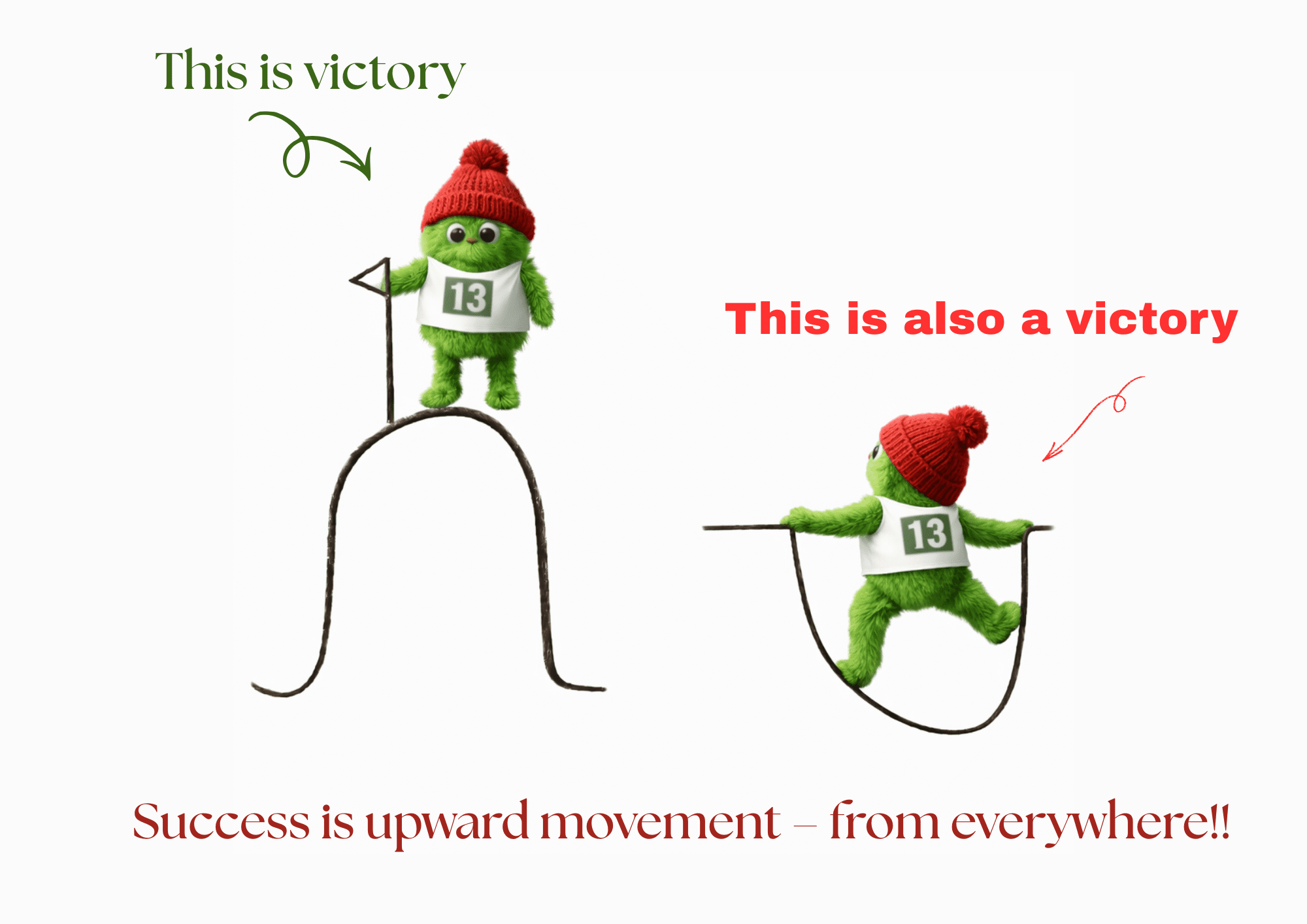
As in the illustration for this article — success is upward movement, from any starting point.
Final Reflection
That final was terrifying.
But it was also real.
It showed that even at the highest level, no one is immune to overload. That the human brain has its limits.
And that sport is not only about medals, but also moments in which a person must face their own nervous system.
Perhaps Friday the 13th was not unlucky.
Perhaps it was a reminder that failure is not the end of the story.
Only its most demanding chapter.
Invitation to Action
If you work with athletes — as a coach, psychologist, parent, or competitor — it is worth asking yourself:
Are we teaching coping with failure as deliberately as we teach technique?
If this topic resonates with you, I invite you to a conversation. We can explore together:
- emotional regulation in elite sport,
- building mental resilience,
- working with competitive pressure,
- supporting athletes after a crisis.